In a world where innovation thrives on collaboration, understanding what people value in their professional connections is more important than ever. To uncover these insights, Venture Café asked 1,000 individuals from diverse backgrounds and locations a simple but powerful question: What do you consider a connection of value?
The answers reveal both universal truths and nuanced differences shaped by geography, roles, and identities. From the global appeal of inspiring conversations to the role-specific emphasis on mentorship, funding, or new networks, the findings provide a roadmap for fostering more impactful relationships. These insights not only illuminate how we connect but also guide us in building more meaningful and inclusive communities worldwide.

KEY FINDING PER LOCATION
Inspiring Conversations: A Universal Priority
“Inspiring Conversations” consistently stand out as the most valued connection type across regions:
- Warsaw, PL leads with 30.37%, emphasizing the community’s desire for thought-provoking dialogue.
- Tokyo, JP follows at 27.15%, highlighting the importance of meaningful exchanges in driving innovation.
- Monterrey, MX (24.49%) and Phoenix, US (29.41%) also underscore the universal appeal of engaging conversations.
Location-Specific Priorities
While “Inspiring Conversations” dominate globally, each location emphasizes unique connection types based on their local needs:
- Berlin: As a startup hub, Berlin values Co-founders or Partners (10.24%) and Investors or Funding (9.84%), alongside A Friend (13.78%), showcasing the ecosystem’s focus on collaboration and financial growth.
- Cambridge: Known for its innovative excellence, Cambridge highlights New Networks (12.50%) and New networks (12.50%) as crucial, aligning with its reputation for intellectual exchange.
- Fukuoka: This emerging ecosystem prioritizes New Networks (21.43%) and Investors or Funding (12.50%), indicating a focus on community expansion and financial support.
- Warsaw: A strong sense of community is evident, with high values for A Friend (21.47%) and Mentorship (7.85%).

ROLE-SPECIFIC INSIGHTS
Academia: Mentorship and Learning
Academics value A Friend (18.31%) and Mentorship (11.27%) the most, emphasizing the importance of intellectual growth and knowledge-sharing in their professional networks.
Startups: Funding and Collaboration
For startups, Investors or Funding (10.98%) and Co-founders or Partners (8.71%) are key, reflecting the essential roles these connections play in scaling ventures. They also value Inspiring Conversations (22.73%), showing that creativity and collaboration remain vital.
Government: Networking as a Foundation
Government representatives overwhelmingly prioritize New Networks (31.37%) and Inspiring Conversations (25.49%), reflecting their role as connectors and enablers of cross-sector collaboration.
Service Providers: Diverse Connections
Service providers rank All Connections Are Valuable (26.80%) and Inspiring Conversations (24.74%) as their top priorities, underscoring the need for broad, adaptable networks.
Investors: Balancing Inspiration and Strategy
Investors prioritize Inspiring Conversations (38.46%) more than any other group, highlighting their focus on thought-provoking dialogue that sparks new ideas. They also value Investors or Funding (17.31%), reflecting the collaborative nature of their work, and Key Decision-Makers (3.85%), emphasizing the importance of aligning with influential stakeholders.
This balance between inspiration and actionable connections enables investors to identify opportunities and build strategic partnerships.
INSIGHTS BY GENDER IDENTITY
She/Hers: Mentorship and Community
Women place high importance on All Connections (24.11%) (the only group not ranking Inspiring Conversation highest) and Mentorship (7.59%), emphasizing the value of supportive and diverse relationships in personal and professional growth.
He/His: Inspiration and Collaboration
Men rank All Connections (18.16%) and New Networks (12.41%) as top priorities, highlighting their emphasis on maintaining diverse relationships and expanding their professional reach.
They/Theirs: Diverse and Meaningful Interactions
Non-binary individuals prioritize Inspiring Conversations (33.33%) the most, and a broad range of connection types, indicating a preference for depth and diversity in their networks.
KEY TAKEAWAYS
Inspiring Conversations emerge as the most universally valued connection type across all regions. Cities like Warsaw, Poland, Phoenix, United States, Tokyo, Japan, and Monterrey, Mexico lead the way in emphasizing the importance of thought-provoking dialogue. These findings highlight a global need for meaningful exchanges that foster creativity and drive innovation.
Beyond the universal appeal of inspiring conversations, preferences diverge significantly depending on roles within the innovation community. In academia, connections with friends and mentors are highly valued, reflecting the sector’s deep reliance on intellectual growth and knowledge-sharing. Startups, by contrast, prioritize relationships with investors or funding sources and co-founders or partners—key drivers for scaling their ventures. Government representatives, often acting as cross-sector connectors, overwhelmingly favor new networks, which align with their role in fostering collaboration across industries. Meanwhile, service providers, who interact with diverse clients, rank “all connections are valuable” as their top priority, emphasizing the importance of adaptable and wide-ranging networks.
Gender identity further shapes networking preferences. Women place the greatest emphasis on the value of “all connections are valuable,” making them one of the few groups not to prioritize “inspiring conversations” (along with Service Providers and Students). This is complemented by their focus on mentorship, highlighting the importance of supportive and diverse relationships for personal and professional growth. Men seem to focus on new networks, reflecting their interest in cultivating a variety of meaningful relationships while broadening their professional horizons. Non-binary individuals place the highest value on “inspiring conversations,” – second only to investors – emphasizing their preference for depth and diversity in their connections.
These findings illuminate the nuanced ways individuals value connections, shaped by their location, role, and identity. By embracing these differences, Venture Café can design more impactful networking initiatives tailored to the diverse needs of its global community, fostering collaboration, innovation, and meaningful growth.

Across the globe, from the bustling streets of Tokyo to the innovative hubs of Cambridge, Massachusetts, the question of entrepreneurship education resonates deeply. Recently, over 800 thought leaders, educators, and entrepreneurs participated in Venture Café’s Global Think Tank, offering their perspectives on whether there is sufficient education on entrepreneurship. The results, gathered from diverse cities, reveal a complex and varied landscape. While some regions are confident in their current educational systems, others are calling for significant enhancements to prepare the next generation of entrepreneurs.
Cambridge, USA: A Balanced Perspective
In Cambridge, Massachusetts, a city synonymous with academic and entrepreneurial excellence, the opinions were as diverse as its storied institutions. While 38.62% of respondents believed that the current entrepreneurial education is sufficient, there was a notable push for more integration at all levels. Specifically, 16.55% advocated for greater inclusion in both higher and lower education, and 17.24% focused on the importance of lower education. An additional 11.03% saw a need for more resources for professionals. Cambridge reflects a community that values its educational traditions but is also eager to expand its approach to entrepreneurship.
Phoenix, USA: A Push for Broader Integration
Phoenix, a city known for its resilience and innovation, showed a strong desire for comprehensive educational integration. Here, 23.70% of participants wanted to see entrepreneurship as a bigger part of both higher and lower education, while 18.50% emphasized lower education. A smaller segment, 14.45%, focused on higher education, with 10.40% advocating for more resources for professionals. Meanwhile, 32.95% of respondents felt that the current state of education is adequate. Phoenix’s results highlight a city that recognizes the need for broader educational efforts to foster entrepreneurship.
Providence, USA: Early Education Advocates
In Providence, the emphasis was distinctly on early education. A significant 45.95% of respondents believed entrepreneurship should be a bigger part of lower education, while 13.51% focused on higher education. Interestingly, 16.22% felt that more resources should be directed toward professionals, with an equal percentage expressing satisfaction with the current educational offerings. Providence’s data suggests a strong belief in the importance of nurturing entrepreneurial skills from a young age.
Tokyo, Japan: Confidence in their current situation
Tokyo presented a unique case with an overwhelming 80.57% of respondents confident that the current education on entrepreneurship is sufficient. The remaining respondents were divided, with 7.43% advocating for more emphasis in higher education, and smaller percentages focusing on lower education (1.71%) and resources for professionals (5.71%). Tokyo’s response indicates a city with strong confidence in its existing educational framework, suggesting that current systems are effectively meeting the needs of aspiring entrepreneurs.
Warsaw, Poland: A Strong Base with Room for Growth
In Warsaw, the majority of participants (59.77%) felt that the current level of entrepreneurship education was sufficient. However, there were notable calls for enhancement: 10.34% advocated for greater integration in both higher and lower education, while 9.20% and 10.73% focused specifically on lower and higher education, respectively. Additionally, 9.96% of respondents saw a need for more resources for professionals. Warsaw’s results depict a city that, while largely satisfied with the status quo, still sees opportunities for strategic improvements in entrepreneurship education.
The Global Picture
When viewed collectively, the global data from Venture Café’s Think Tank reveals a world that is both reflective and forward-thinking about entrepreneurship education. While cities like Tokyo and Warsaw display a strong belief in their current systems, others, such as Phoenix and Providence, are calling for broader and more integrated approaches. This global conversation highlights the varied needs and aspirations of cities around the world, all united by a common goal: to empower the next generation of entrepreneurs through education.
Venture Café’s insights provide a roadmap for future efforts, emphasizing the importance of tailoring educational strategies to the unique needs of each community while also recognizing the universal value of entrepreneurial skills in today’s rapidly evolving world.
What do you think? Let us know through email or social media!
As Earth Day approached in April, we asked our Venture Café visitors around the globe their views on our planet’s future. We’re delighted to have received responses from 600 passionate individuals across various sectors, from Academia to Startups. Your insights highlight our collective priorities towards the UN’s Sustainable Development Goals.
The efforts in our community in fighting poverty, promoting education, and championing climate action are shaping a brighter future. We value your opinions and would love to delve deeper! If you’d like to discuss these findings or share more insights, please reach out to us. Together, let’s continue to inspire and drive positive change for our planet. Thank you for being a part of our vibrant community! 🌏💚
Global Think Tank, April 2024 : Are you working towards the UN Sustainable Development Goals (SDG) in your Organization?
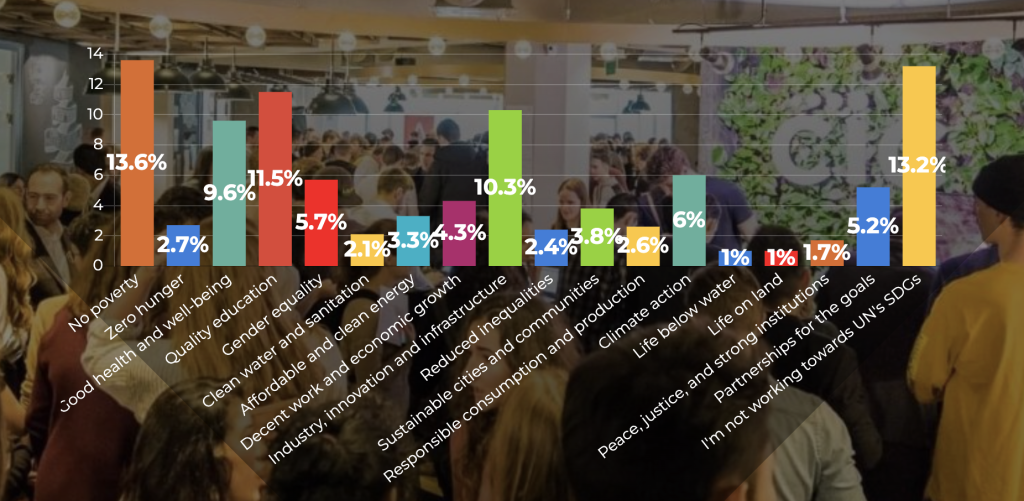
Let’s have a closer look at some insights and trends that we found among our visitors, divided on the role in innovation ecosystem:
- Startups are carving out their niche with a strong focus on Quality Education, No Poverty, and Industry, Innovation, and Infrastructure. Despite lower overall engagement across other SDGs, these young organizations are laying the groundwork for future growth and impact. Picture startups receiving the support and resources they need to expand their sustainability efforts, driving change from the ground up.
- Government participants emerged as champions of Good Health and Well-being, Quality Education, and No Poverty. Their focus highlights a deep commitment to public health and education, striving to create policies that uplift communities and eradicate poverty. Imagine a world where government initiatives ensure every citizen has access to quality healthcare and education, laying the foundation for a prosperous society.
- In the corporate world, the drive for Good Health and Well-being, No Poverty, and Quality Education stands out, along with a significant focus on Industry, Innovation, and Infrastructure. These entities are blending social responsibility with business innovation, envisioning workplaces where health and education are paramount, and cutting-edge infrastructure propels us into a sustainable future. Picture companies that prioritize their employees’ well-being while pioneering technologies that reshape our world.
- Students showed a unique trend, with a notable percentage not currently working towards the UN’s SDGs. This points to an opportunity: empowering the next generation with the knowledge and tools they need to engage in sustainable practices. We envision campuses buzzing with sustainability initiatives, where students lead projects that directly contribute to global goals.
- Investors demonstrated a keen interest in No Poverty, Good Health and Well-being, and Quality Education. This focus suggests a blend of financial acumen and social consciousness, where investments are made not just for profit, but for profound societal impact. Envision investors supporting projects that uplift communities, reduce poverty, and provide educational opportunities, all while achieving financial returns.
- For Service Providers, the emphasis on Quality Education, No Poverty, and Industry, Innovation, and Infrastructure indicates areas where they can make substantial contributions. However, their lower engagement across other SDGs suggests room for growth. Imagine service providers expanding their initiatives to cover more SDGs, becoming pivotal players in the sustainability landscape.
- Lastly, Academia stands out with a strong commitment to Good Health and Well-being, Climate Action, and Quality Education. However, a noticeable percentage are not yet actively working towards the SDGs, signaling an area ripe for increased awareness and action. Envision academic institutions where sustainability is woven into every curriculum, research project, and campus activity.
As we reflect on these insights, one thing is clear: our community is passionate and diverse, each role contributing uniquely to our shared vision of a sustainable future. Together, we can build a world where every action, no matter how small, drives us closer to achieving the UN’s SDGs. So let’s continue the conversation, share our ideas, and work collectively to make this vision a reality.
Join the conversation every Thursday! Check out our program here!